jueves, 28 de marzo de 2019

Katie's Amazing World: A Minecraft Birthday Party

By Angie

Note: Here's our first special THROWBACK THURSDAY!
(In which I finish and post a draft of an article I started a couple years ago! This party was thrown in 2012, but my kids STILL love and play Minecraft daily so I felt it would be worth sharing. Enjoy!)


I previously wrote an article about bringing your favorite games and video game characters to life in party form: "How to Throw a Great Character Game Party", and this time we took on the kids' favorite open-world creative game Minecraft! Here's the basics of how we did it broken down into the 4 essential steps:

Decorate!


The first step to any party or event is to set the mood, and in this case we wanted a fun Minecraft feel, with the block-y pixel charm, and since it was a party for 7 year olds (some of whom might not be familiar with the game) we wanted it to feel fun and accessible as well. Katie was all in on making decorations, and had some help from a friend before the party. This was great to have the girls set on this task while we were busy with other preparations..


Steve-heads and Creepers were an easy choice as they were easily recognizable as Minecraft, and relatively easy to make.


We used the Steve-heads and Creepers to decorate our favorite Happy Birthday banner (with some lights to draw attention to their handiwork!)


While the girls were lining the house with Steve's, creepers, and other blocks, we set to work on making another Minecraft staple: the Crafting Table. We wanted something that served as a decoration and also was part of the activities part of the party, so we printed out some patterns which were used in some of the crafts and had them stewn about the table.


Build! 


Building is such a core part of the Minecraft experience, we knew we had to come up with ways for the kids to build stuff at the party if we wanted to capture that Minecraft feel. Because of their age, "melty" beads (also called Pearler Beads) seemed like a great fit for a craft project. They were bright, colorful, presented lots of options for following patterns, and are just really fun!


Some of the kids made their creations without help, but we had adults standing by for crafting assistance. We also had keychain loops to turn the finished product into something that could be hung off of a backpack zipper of otherwise displayed. 


We also had paper available for collaging, as Pearler beads require a lot of manual dexterity (and patience) and we had some younger kids at the party, so we wanted to make sure there was something they could craft with the patterns as well. 


Even the older kids got into the crafting, and we saw some really elaborate creations made throughout the course of the party. Of course there was a Diamond Sword, the pinnacle of Minecraft weaponry. 


Play!

Immersion into a world is one of the best parts of gaming, so we also wanted to make sure there was a way for the kids to jump into the Minecraft world and play the role of the survivor, striving to build a life and drive back the bad guys. Our first goal was to make some bad guys, and of course some weapons with which to fight them!


"Do you like my sword-sword-sword? My diamond sword-sword! You cannot afford-afford, afford my diamond sword-sword"! You've all seen that video, right? My kids sang that for months. Anyhow, back to the party!


We made a Ghast pinata, and a Diamond Sword and a Diamond Pickaxe with which to break it open, and the kids were beyond excited to take their turns attacks the "mob" and of course hoping for candy! (They all used the sword though, who wants to fight a mob with a pickaxe? What were we thinking?)


To simulate the survival and build aspect, we filled our house with cardboard boxes for the kids to use as building blocks. They created houses, castles, forts, walls, and many other things (to inevitably knock down and rebuild!). If the party hadn't been in November in Oregon (both cold AND raining) this part would DEFINITELY have been outside! 


We also had a few computers and the Xbox set up where you could actually PLAY Minecraft, but the kids were so busy with the party activities they only got used by the cousins before and affter the actual party. But you can see that lure...


Eat!


Of course, all heroes need to eat. Much like decorates, food can help set the feel for a party. We decided to go all in on the blocks and do all cube foods, then let the kids have the fun of playing with their food AND building some more! One of the challenges was finding foods that could be cubed and could at least sort of be eaten together. Our menu consisted of fruits, veggies, cheeses, crackers, and breads, all of which are favorite snack foods for busy kids. We also did our best to replicate the Minecraft cake that you can craft in the game, which scored bonus points with the birthday girl! 


Maybe some grownups played with their food too....


The cake is a lie! Wait, wrong video game reference. This cake was amazing. 


So that's how we pulled off an amazingly fun, memorable Minecraft themed party for our little adventurer. I feel that a game makes a pefrect theme for a birthday party (or other type of celebration) because it is already structured around doing something fun, usually has a rich world to draw from, and gives the party-goers a great way to socialize and engage in something more memorable than some of the typical party fare.

Hit us up with any questions, comments, or let us know what your favorite game-inspired party ideas are in the comments! Have fun playing!


Top 11 Games Of 2018

We chose our top 10 based on number of hours played, with a minimum of 5 plays per game throughout the year. This year we had a tie for fifth place and a three-way tie for eighth place, creating the need for a top 11. Besides, one more game won't hurt anyone...

The big surprise this year is how few games from last year's top 10 made the list, the biggest shocker being not only that X-Wing not make it into the top 10, but we didn't play a single game of it in 2018. I chalk this up to us spending a lot more time playing other miniatures games, and also a lack of interest in the recently released X-Wing Second Edition.


11 (tie). Covert

5 plays, 12.5 hours (average play time 2.5 hours per game)

A lavish game that's relatively simple yet very engaging. I love the cold war spy genre, and Covert evokes that nicely with it's European setting and cards representing spy gadgets like miniature cameras and briefcase tape recorders.

Read the full review.


10 (tie). Doctor Who: Time of the Daleks

5 plays, 12.5 hours (average play time 2.5 hours per game)

2018 was the year we finally got some decent Doctor Who tabletop games. This one manages to capture the feel of Doctor Who quite well but it does seem a little incomplete, an issue that will hopefully be remedied by the long-delayed expansions that will hopefully see the light of day soon.

Read the full review.


9 (tie). Lord of the Rings Trading Card Game

5 plays, 12.5 hours (average play time 2.5 hours per game)

At the behest of a friend who wanted to try it, we got this old gem out and actually spent a fair amount of time playing it this year. I still maintain that it is one of the most well-designed trading card games ever published.

Read the full review.


8. 7TV

5 plays, 13.5 hours (average play time 2.75 hours per game)

We've built up a fairly large collection of miniatures and terrain for this great skirmish game based on British "spy-fi" television of the 1970s such as The Avengers, The Prisoner and Life on Mars. The rules do a good job of providing a framework that allows us to immerse ourselves in the setting, which to me is the whole reason to play games like this.

Read the full review.


7. Yamataï

5 plays, 14 hours (average play time 2.75 hours per game)

I'd be rich if I could bottle and sell whatever it is that makes Marc Paquien's artwork so appealing. Thankfully, with Yamataï it's backed up by a very interesting exploration and resource management game.

Full review to come.


6 (tie). Clank! In! Space!

6 plays, 14 hours (average play time 2.5 hours per game)

I'm a big fan of deck-building games, but the can tend to get a bit repetitive. This one innovates by adding a board with a movement mechanic, as players attempt to rob an evil despot's space ship before anyone notices.

Full review to come.


5 (tie). Cthulhu Wars

6 plays, 14 hours (average play time 2.5 hours per game)

Cthulhu Wars is one of only two returning games from last year's top 10 list. Apart from the exceptional miniatures, it really is a compelling Risk-style strategy game.

Read the full review.


4. Doctor Who: Exterminate!

6 plays, 16.75 hours (average play time 2.75 hours per game)

We were a little lukewarm on this skirmish game when we originally picked it up in 2017, but the growing range of miniatures has rekindled our interest, especially since we can use the same tabletop terrain we've been assembling for 7TV.

Read the full review.


3. Dinosaur Island

9 plays, 23 hours (average play time 2.5 hours per game)

This was one of my most anticipated games for this year, and I wasn't disappointed. It's a great engine-building game, and the recent expansion makes the game more interesting without making it more complicated.

Read the full review.


2. Conan

19 plays, 27.5 hours (average play time 1.5 hours per game)

The only other returning game from last year's top 10, Conan dropped one spot but still saw plenty of play in 2018. Part of this was due to an 8-week campaign that I talked one of my roleplaying groups into, but the ability to play this game as an ongoing series is part of what makes it such a great game.

Read the full review.


1. Mythic Battles: Pantheon

21 plays, 37.5 hours (average play time 1.75 hours per game)

Apart from the great miniatures, gorgeous artwork, and well-designed rules, the nicest thing I can say about this game is that every time we finish a game we want to play again.

Read the full review.


Honorable Mention


Western Legends

5 plays, 11.5 hours (average play time 2.25 hours per game)

A great open world adventure game set in the wild west. The fact that we played this game four times in the first month we got it tells me that it probably would have placed in the top 10 if we'd had it earlier in the year.

Full review to come.


Most anticipated game of 2019


Core Space

This game looks simply amazing. A board game/skirmish hybrid similar to Mythic Battles: Pantheon or Conan, with an intriguing semi-cooperative element that puts players in competition with each other for resources, but both at threat from an invading hoard of killer robots. And rather than just a flat, printed board, it comes with Battle Systems 3D terrain.

miércoles, 27 de marzo de 2019

Suzy Cube Update: March 16, 2018

#SuzyCube #gamedev #indiedev #madewithunity @NoodlecakeGames 
Unfortunately, I've been sick this week. That means a short update for a couple of reasons: 1. I spent a lot of time resting and 2. I want to get this over with so I can go back to resting. So, on that positive note, let's get it on!
Read more »

martes, 26 de marzo de 2019

Ronin - Lion/Scorpion Clan Wars - Skirmish Battle Report

Ronin 
Lion/Scorpion clan wars 
 Skirmish - Battle report


SKIRMISH WARGAMES IN THE AGE OF THE SAMURAI

"Set in an age of feuding samurai, wandering swordsmen and fearless warrior monks, Ronin is a skirmish wargame that captures the flavour and excitement of such Akira Kurosawa films as Seven Samurai and Yojimbo. Whether they prefer the loyal samurai retainers of a feudal lord or a horde of desperate bandits, players choose from one of several factions and build forces to battle for dominance and survival in 16th-century Japan. They may also recruit swords-for-hire to supplement their forces - masterless ronin, martial arts masters and secretive ninja will lend their skills to any commander who can afford them. A full points system, incorporating a wide range of equipment and skills, allows for detailed customisation of characters, while scenarios and a campaign system permit them to gain experience and develop over time. The fast-paced rules simulate the cut and thrust of hand-to-hand combat and require the player to make tactical decisions in the middle of a fight, immersing them in an era of war." -Osprey publishing


Ronin on Osprey publishing 

I Have used this as a ruleset to play skirmish battles in the setting of 
"The Legend of the five rings". 


The Lion clan and the scorpion Clan are currently at war. The Lion clan have invaded the Scorpion lands.  Many battles are fought some are told some are not. but all of the battles contain great heroism and glory. Here are some accounts of the war that you may not of heard.


Outside Kumoshima village in the Scorpion lands

This was the moment that he hoped would never come. Bayushi Hideo looked around at the arranged Ashigaru in the shining sun, It was the middle of the day when the Ashigaru were summoned from the Kumoshima village. The Ashigaru-Gashira  drilled the handful of men, he didn't want to look at their faces, he knew already. The grim determination to protect their village from the invading Lion clan, clearly etched on their faces.  He had already sent a messenger to gain assistance, but it would be at least a day before they could get to the village. He had hoped that the lion Clan wouldn't be interested in such a small village in a quite poor district, but it did have a good location as a staging area into the next district into the south.  Hideo clenched his fist in annoyance. The Lion will pay for this. He would meet them head on before they could get to the village. Stepping forward, he gestured to the Ashigaru-gashira " Lead them out"
He had always dismissed Ashigaru but today he was thankful for their courage, for he knew they were facing a formidable opponent. The Ashigaru marched with Yari and Nagae-yari ready. 


The Lion Samurai slowly stalked through the woods of the mountain pass, their orders where to scout out the terrain, they were told about a village up ahead. Soon the terrain changed as the mountain pass dropped to a bare plain with a few tortured trees.  At the bottom she spotted the unmistakable red of the Scorpion clan just beyond the trees, she gestured to her fellow Lion Samuari Matsu Shintaro  "what can you see?"
Shintaro stood still, surveying the barren plain in front. The clear morning making it easy to see. "Looks to just be Ashigaru, with a Samurai leading.  Could be a patrol?"
Matsu Kaya unsheathed her Katana, "Let's make sure they can't return with a report. "

The Lion Clan force marched down the Mountain pass.


Mission


This is a Skirmish of 150pts each side.

Lion Clan - Minor objective -  Kill more than 75% of the enemy Buntai.

Scorpion Clan - Minor objective -  Lose no more that 20% of your force

(Completing a Minor Objective offers five additional Victory points)

Forces


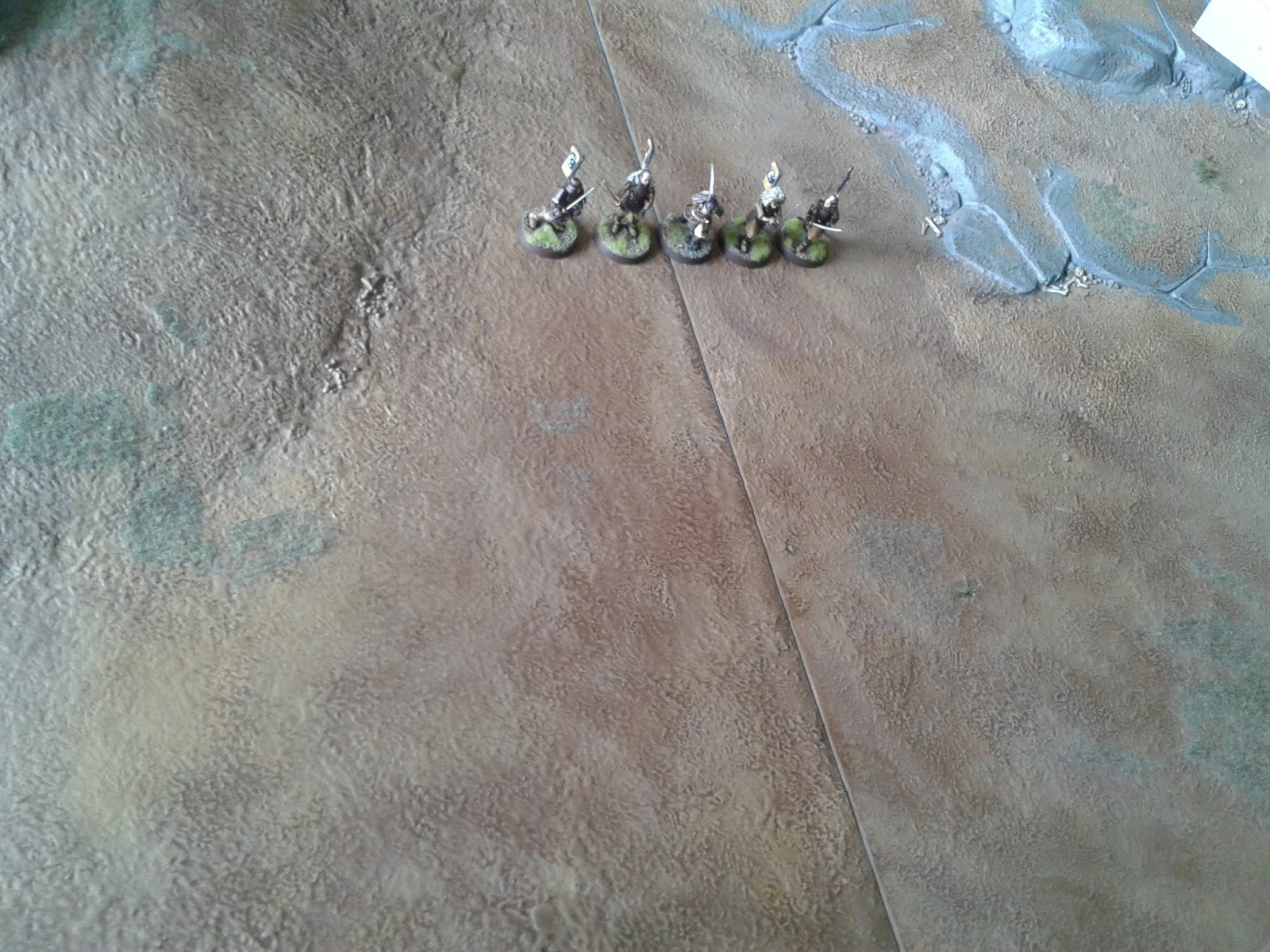
Lion Clan Attackers - (Left to right) Akodo Okimoto, Akodo Soji, Matsu Kaya, Matsu Takakage and Matsu Shintaro.

Matsu Kaya -Hatamoto Rank 4 with two skills (Powerful and Kenjutsu)
Matsu Takakage - Samurai Rank 3 with one skill (Kenjutsu)
Matsu Shintaro - Samurai Rank 3 with one skill (Powerful)
Akodo Soji- Samurai Rank 3 with one skill (Fast)
Akodo Okimoto - Samurai Rank 3 with one skill (Tough)


The Scorpion Clan Defenders - Bayushi Hideo and his Ashigaru troops

Bayushi Hideo- Samurai Rank 3
Ashigaru- Gashira Rank 2
2x Ashigaru Rank 1 With Nagae-yari
3x Ashigaru Rank 1 With Yari
Ashigaru Rank 1 with Yumi


Deployment


Deployment on the barren plain

Scorpion defenders deploy


Lion attackers deploy coming down from the mountain pass


Turn 1 


Bayushi Hideo watched as the lion force descended from the mountain pass. No doubt they would be able to see the scorpion forces, he smiled behind his mempo, The Lions they won't be expecting such an openly aggressive move. The thought gave him hope.


Turn 2 
Akodo Okimoto wounded from lone ashigaru archer

Bayushi Hideo saw one of the Lion Samurai take  an arrow in the shoulder, to his surprise, the warrior barely registered the wound. The tough samurai, snapped the arrow and continued his charge 

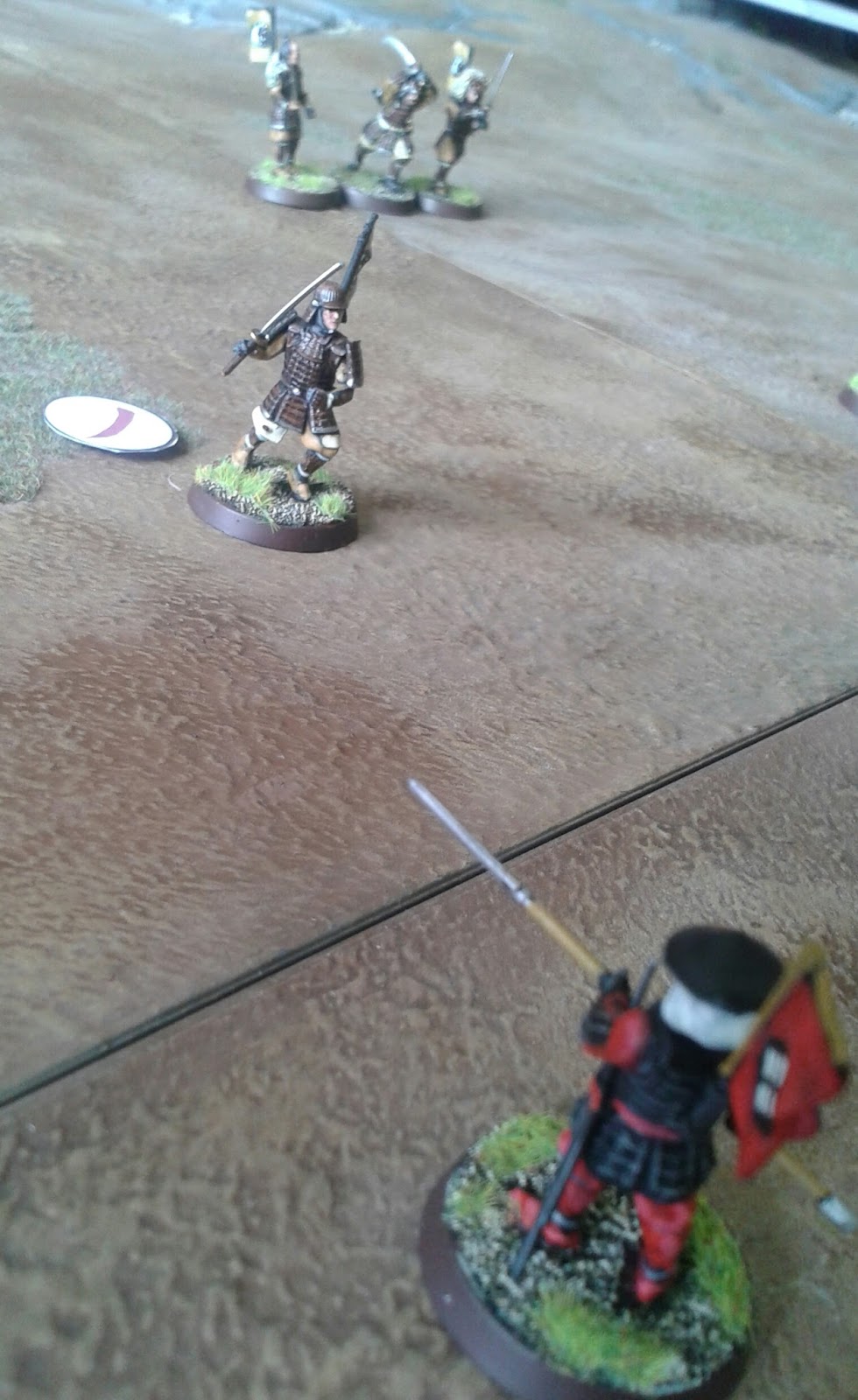
The two forces rush towards each other 


Turn 3


The Ashigaru charged for forward to engage the Lion samurai head on.

The Ashigaru swarm against the Loin clan samurai 

Akodo Okimoto spotted  the unengaged Scorpion Samurai and charges in for the kill. Bayushi Hideo saw the eager Lion and was ready, after a flurry of uncompromising swordsmanship, neither samurai were able to get advantage over the other.


Matsu Shintaro found herself on the wrong side of the Ashigaru Yari's and the numbers were against her, she took a Grievous wound whilst delivering a light wound to one of the ashigaru. 


Matsu Takakage and Akodo Soji isolate an Ashigaru and 
with accurate strokes kill the unfortunate soldier


Matsu Kaya Smashes through the line of ashigaru leaving her alone against the Ashigaru- Gashira.


Turn 4


The Samurai of the Lion clan's superior combat ability was beginning to take its toll on the Ashigaru, the advantage of numbers slowly ebbing away to the onslaught from the Lion clan Samurai. 


Bayushi Hideo parried the sloppy attacks from Akodo Okimoto, he quickly found the opening and struck, the Lion staggered back, blood gushing from his sliced armour. Still on his feet he fought of the attack from an Ashigaru archer. The sheer robustness of the Lion warrior surprised him even more.


Matsu Takakage moves up to help against the Ashigaru.

The Ashsigaru-Gashira tried his hardest to defend against the Lion Hatamoto, but was no match in skill or power.  Slowly Matsu Kaya bent down to take the Ashigaru-Gashira's head as a grim trophy. Glancing around she noticed the enemy leader in combat with Akodo Okimoto.  She could see that her fellow lion was injured.  


Turn 5


The enraged Lion Clan Hatamoto Matsu Kaya charged at the crimson armoured Samurai of the Scorpion Clan. The Scorpion Samurai was knocked off balance from parrying and only his fast reflexes stopped him from a swift decapitation, however the lightning fast attacks from the Lion Samurai made a mess of his armour and he could feel the warm blood flowing over him from several wounds. Hideo's head was swimming; the loss of blood affected him badly, finding it hard to focus.
Matsu Kaya smashes into the Scorpion Clan Samurai, causing a grievous wound.

Matsu Shintaro slices down another eager Ashigaru.


Turn 6


Matsu Shintaro dashed over and struck the Ashigaru archer , sending her opponent to the floor, the archers head followed soon after.


The Scorpions forces where now seriously thin and the Samurai was locked in combat.
Bayushi Hideo fought for his life against the clearly more proficient warrior. His head was still swimming. He knew he was just holding out.The sword slashes where fast but neither Samurai could find an opening in each other's defences. Still the moment came, the Scorpion Clan Samurai lost focus from the loss of blood for just a moment, but it was all that the Lion Warrior needed.
Matsu Kaya took another head as a trophy.

The clash between the two champions see's the Lion Clan Hatamoto come out on top. 


Claiming trophies - A model that is not in combat or dazed may take a head from a slain enemy, if this model survives the battle their side gains one additional victory point for each head taken as a trophy. 


Gaining victory points -  Each side gains victory points (vp's) equal to the rank of each enemy model killed.


Turn 7- Final Turn


Akodo Soji finishes off the badly wounded Ashigaru


Final Victory Points

Lion Clan -  24 
Scorpion Clan - 0


Winner - Lion Clan


The last ashigaru slumped lifeless to the ground.

Matsu Kaya looked around at the headless Scorpions. Noticing the lack of samurai concerned her. She was expecting more.
"This was either a token defence or a desperate last stand? " she said as she sheathed her blade.
It was Akodo Okimoto who spoke up " Either way I feel we may have further resistance towards the village" his voice barely contained the strain from his injuries.
"Agreed make sure everyone is able to continue, we must press on. we must not allow the scorpions to gather their forces. " Ordered Matsu Kaya. 
Quickly and efficiently they Lions gathered their trophies and began to travel further in to the Scorpion lands.


Western Borders - AD&D - Session 0 Recap

The first Roll20/Discord game set in my Etinerra world happened last Tuesday. We're going to meet every other Tuesday, from 7 to 9(ish) CST.

The cast of adventurers:

Corvin - a human Cleric of Yorkai, the pagan god of doors and thresholds.
Karl - an elven Magic-User/Thief
Mort - a bedraggled, mostly-naked human Druid, with some squirrels running around him
Fascul - a human Fighter
Obroam - a human Paladin, a champion of Tangadorin, the pagan god of light and revealing secrets
Pickles - a littleling (halfling) Thief

The first hour was normal session 0 stuff. Discord worked VERY well for our audio - there were none of the issues that I had experienced earlier in the year when I attempted my Ultima game online.

Then, we got into the "You meet..." part of the game except it was a bit different for the meeting:

* The PCs were traveling to the Duchy of Elthest, in the company of a group of (very) rural merchants and their horses. Their destination was the backwater village of Gireford.

* Terry and York spoke about rumors of recent attacks on travelers from the forests to the south of this trail.

* The party was surprised by an ambuscade of kobolds, which kill York's favorite horse in their opening hail of arrows!

* A merry battle, in which 2 PCs go to -1 hit points and 1 hit point. Terry takes off running away, screaming. York jumps into the fray alongside the adventurers.

* Karl was the kobold killer, knocking several down with his deadly bow, along with Mort, Fascul and Obroam. Seven kobolds are slain, they know of one that got away.

* Mort, after urging the remaining horses away from battle, and having a moment of silence for the dead horse, has a squirrel follow the fleeing kobold (and thereby selecting "follow" as a trick that he is teaching his animals as a result of the 'Animal Friendship' spell)

The PCs earned 700xp for killing the kobolds. They were very impressed that York had joined in the battle.

Our next session is on Tuesday, Dec 18th.

6 Reasons For Having A Defenseless Protagonist

Not having any combat can be really helpful to horror games and crucial in delivering the desired experience. This article presents the top 6 reasons for this and also explains how it ties into narrative games in general.


Outlast 2 has recently been released and has spurred a lot of discussions around not giving the protagonist any means to fight back. I haven't played enough of the game to be able to give an overall impression of it (I'm just 30 minutes or so in), but I think I've seen enough to weigh in on the discussion. We at Frictional have been knee deep in this problem since 2006, and I've been up against the problem myself ever since I made my first hobby horror game in early 2000. This is something I've been thinking about for almost 20 years, and hence something I have a strong opinion about.

The discussions around weaponless protagonists is often focused on horror games. It's really a question that concerns narrative games in general, though, and isn't just about what sort of horror you want. It's really about what sort of approach you want to take to storytelling. It also has a lot to do with my recent post on mental models, which makes this a good time to go into it.

---

Let's start with the main reasons why you would want a game with a defenseless protagonist. This is by no means an exhaustive list, but it brings up the most important reasons.


1. It makes the player assume the appropriate story role
To someone with only a hammer, every problem will look like a nail. The same is true for the tools that we give to a player. The actions that we let the player use informs them about the role they are supposed to play within the game. It's really hard to make the player feel like a detective if they never get to do any actual detecting.

Why is this the case? Because the way we interact with the world around us is via a mental model. This mental model is built from a network of connected attributes, all having do with the various aspects of our world. When taken together this gives us a sense of how the world behaves and what we are dealing with. So when we see a character looking for clues in a crime scene, interviewing witnesses and trying to piece together evidence, it'll point towards the idea that this person is trying to solve a crime. This creates a strong belief that the character is indeed a detective. If we are simply told a character is a detective but only see him chopping wood it is really hard to take the first statement seriously. You will never model this character as a detective. No matter how many times you tell me that a pile of sharp glass is a chair, I will not perceive it as one. It simply lacks any of the attributes that I associate with things that are chairs.

In the same way, in order for the player to feel like they are inside a horror story they need to have access to the actions of the protagonist of a horror story. In horror the protagonist is supposed to be vulnerable, uncertain, and out of their depth, and to get this across to the player you need to restrict their available actions to support this. A really simple way to do this is to simply skip any means of fighting back. Sure, you can always make weapons less effective in the game, but the moment you give them any sort of weapon it's likely to awaken deeply rooted mental models in the player. We humans are really good at generalizing and unconsciously judge many situations on the first pieces of evidence we can get our hands on. So when you introduce a weapon in a horror game, the player will view the game as one where the primary action is combat and then by assumption add a variety of other attributes to the experience. This is something we experienced firsthand when making Penumbra: Overture where player would even treat an old broom as a potential weapon.


2. It make monsters feel like threats

Just as the actions at your disposal informs your role, so do your interactions inform what sort of world you are in. If the player's main action is to shoot down monsters, the monsters become target practice. Again this is mental modeling. Just like we determine something to be a chair by determining its shape, how well it can be used for sitting, and so forth, we also evaluate any dangers by what attributes we can assign to them. When "thing that I shoot to generate fun gameplay" becomes a strong attribute for a monster, a lot of the horror is lost.

If, instead, monsters are things that the player interacts with only by running away and hiding from them, the mental model becomes quite different. You start to draw connections to other things that you would run away from, and this jacks much better into your primal fear response. The monster is no longer a game object connected to a core combat loop. Instead it becomes an unknown entity that you have no means to fight. This makes a huge difference to how the player perceives the threat.


3. It leaves more to the imagination
Another problem with being able to fight any creature is that this requires many close up encounters. You need to aim at the creatures, see feedback of them being hit and so forth. Most importantly, in order for this gameplay to work you need to have lots of actual confrontations. This goes against one of the most important rules in horror: leave the monsters as vague as possible.

When your gameplay doesn't rely on combat, it's much easier to keep the monster out of sight. When you are running and hiding, the monster doesn't really need to be visible at all. You can just rely on the player seeing quick glimpses, hearing sounds, watching a motion tracker and so on in order to sustain the gameplay. This gives a lot more room for the player's imagination, and allows them to conjure up far scarier monsters than what could be rendered using polygons.


4. It makes the player paranoid
Checking how much ammo you have left, thinking about what gun to have available, planning for ammo usage, looking for items and so on - all of these are activities that the player constantly has on their mind when playing a shooter. And all of these take up mental resources that could have been used for other things instead. It's very important to know that the player has a limited amount of focus and whenever you tell the player to give something their attention, something else will have less attention. Remember this as a designer: whenever you say yes to something, you say no to something else.

What this means is that when you remove any form of combat, the player has a lot of mental focus to spare. In fact, many players will have too much. This almost leaves the player is a state of sensory deprivation. The outcome of that is that they start to pay a lot of attention to small details. It makes players more paranoid, more prone to invent reasons for small sounds and so on. This is an extremely good state in which to play horror. It's also something you lose if you give the player too much else to think about. We noticed this ourselves in Amnesia: The Dark Descent, where many levels where made better by giving the player less to do. This encouraged them to fantasize more and gave the unintuitive result of increasing their engagement,


5. It makes it harder to optimize away emotions
A combat system is something that the player often has played hundreds of hours of before. Sometimes much, much more. There are lots of well-known tactics for dealing with encounters, and players often come with a huge instinctual toolset on how to bypass various dangers. What this means is that there is ample opportunity for the player to figure out ways to beat the monsters. In turn, this means that the monsters lose their core attribute, to be horrible threats, and instead just become standard gameplay objects.

It's much harder to do this in a game without combat. When you don't have a set loop that the player uses to interact with the game's world, it becomes much harder to figure out underlying systems and to optimize. This means that the player has to rely more on their imagination to make a mental model of the world and its inhabitants. If the systems that drive the monsters are obscure, you have to think of them as living, breathing creatures and this greatly heightens any emotions that you associate with them.

Of course, if you use non-combat oriented gameplay in the wrong way, you will fall into the same trap. This is something I'll go over in a bit.


6. It is a great design constraint
As I noted before, games are often too much fun for their own good. This is most certainly true for combat. In fact, combat is probably the most common core mechanic in games. It's really easy to come up with engaging ways for you to do it. So the moment that you decide that you will have combat, it makes it so much simpler to come up with engaging scenarios for a game. This means that you are very likely to overuse combat and to drop focus on the narrative you are trying to convey.

When plot dictates that the player has to go through a sewer, how should we make this section engaging? With combat this answer is easy: just add some monsters and have the player fight them. Problem solved! You see this over and over in games that use combat, especially horror games. Even though it is clear that the focus ought to be on delivering a certain end experience, there are tons of areas that, by being satisfied with just having simple combat, counteract this goal.

If you don't have combat, you don't have this option. If your basic gameplay is just running and hiding, it's actually quite the opposite: your core mechanics are not much fun. This means that you need to think of ways to vary them, you need to be careful when to use them and there need to be other activities involved. This forces you to avoid any easy solutions. Simply relying on "add some monsters for the player to encounter" will not work in the long run. It will soon become very tiresome to play the game, because you are relying gameplay that is, at its core, not engaging enough to be the driving force of the experience.

---

That concludes the list of the most important reasons why a defenseless protagonist is really good to have in a horror game. Now I will go over a few common counter-arguments, and respond to them.

Claim 1: "Without combat, the game becomes boring"
I think this is both true and untrue. 

It's true in the sense that in order to get the player to experience certain things, such as the paranoia that comes with sensory deprivation, your game simply cannot be too much fun. This is how narrative works in other media as well. Certain experiences cannot simply be made into a super-engaging package. There needs to be a certain level of "boredom" for it all to work. The experience as a whole must of course be engaging, but not every game can have the moment-to-moment excitement like something like Doom. 

It is untrue in the sense that we haven't yet seen what can be done without having combat. Many people simply compare the current state of games with defenseless protagonists to the current state of games with combat, and then take this as how it will always be. I think there's a lot that can be done in order to make interesting defenseless horror, or other narrative experiences for that matter, and still have a level of "gaminess" on par with that of a shooter. The problem is that combat gameplay comes naturally and has had 40 years to evolve; gameplay without combat is much harder and has had much less time to evolve.

I have to admit that I am growing quite bored with the standard "run and hide"-gameplay. I think it can work when used in short bursts, but it's far from an ideal solution. We need to think harder and dig deeper in order to improve gameplay for horror and other narrative games. That is basically what this whole blog is about and something Frictional Games is investing heavily in. This is uncharted territory and there is huge room for improvement.


Claim 2: "No combat leads to lots of trial and error"
If you look like a game like Outlast 2, this is certainly true. There are a bunch of sections where you have to replay over and over in order to continue. This all boils down to Outlast 2 using the "run and hide"-gameplay as a foundational element of the game, and it's interesting to discuss why this must give rise to so much trial and error.

The first reason is that it is very hard to have a good analog feedback system. In a game with combat it's much easier to have stats for things like health and ammo which you can vary during an encounter and use as feedback. But in a game where you are trying to not get caught, the situation is much more binary. You either get caught or you don't. So the moment you need to give the player the feedback that they are "not playing correctly" that usually means killing them off, and forcing them to start over again.

The second reason is the fact that player failure means death and restart. This doesn't have to be the case. Few things break our immersion as much as having to replay the same section over and over. In fact, in order keep a level of presence you are almost obliged to make sure this never happens. Every time you pull the player out of the experience, you break the illusion and force them to build up the fantasy from (almost) scratch again. Player death is a huge problem in narrative games, and despite this, very few games try to deal with it.

Again this is something I think that has lots of room for improvement. It is also something that we at Frictional Games are trying to solve in both of our upcoming games. The goal is to have an experience where you never see a "Game Over" scene, yet feel a strong sense of being able to fail and is very anxious about not letting that occur. This is not an easy challenge, but it is also one with huge potential. Staying immersed and feeling your actions have consequences are big reasons why interactive storytelling is so interesting, and even small improvements can come have great impact.


Claim 3: "Not having combat is unrealistic"
This claim is highly dependant on what sort of experience you are trying to create. Sure, if you are doing a videogame version of Aliens or Deep Rising, it's a great fit. But as I have outlined in this ancient blog post, there are many different ways in which combat is featured in horror movies. If you want to do a videogame version of The Exorcist then combat will play a much smaller role - probably none. Most of the time, weapons are there as a last line of defense for the protagonist(s). From that angle it makes sense that you should have at least have some form of defense. But you also have to consider all of the negative aspects, many of which I listed earlier, that come along with having combat. If a horror story should "realistically" let the protagonist use a weapons in two or three places, then it might make more sense to try and make these places go away somehow.

Another way to approach this is to have combat in ways that doesn't imply your standard combat mechanics. Weapons could be puzzle items that the player have to be careful about when they use them. It's also possible to use the environment as a means of defense. The point I'm trying to make here is that it's possible to retain a sense of realism without reverting to full-blown combat mechanics.

Either way, I think the most important question to ask is: "What is the best way to achieve the intended experience?". If combat is the best way, even if you take all of the downsides into account, then by all means go in guns blazing!

---

Most of these discussions have centered around horror games, but really most of these things apply to any narrative game. It's not just horror games that strive to keep the player's imagination going or want to avoid players that optimize away emotions. These are foundational issues for any game that wants to try and tell a story. The problem of not being able to rely on an engaging set of core mechanics is also something that goes beyond horror games.

Thinking about why we want a defenseless protagonist in the first place and then figuring out means to make it better feels like a really important question to me. It connects to many of the core issues that face a game that wants to focus on narrative, and any improvements are bound to be helpful to interactive storytelling in general.

Next week I will present a system that will allow us to more easily think about these issues, and will hopefully also make it easier to find solutions.

sábado, 23 de marzo de 2019

ouo.io - Make short links and earn the biggest money


Shrink and Share

Signup for an account in just 2 minutes. Once you've completed your registration just start creating short URLs and sharing the links with your family and friends.
You'll be paid for any views outside of your account.

Save you time and effort

ouo.io have a simple and convenient user interface, and a variety of utilities.
We also provides full mobile supports, you can even shorten the URL and view the stats on a mobile device.